
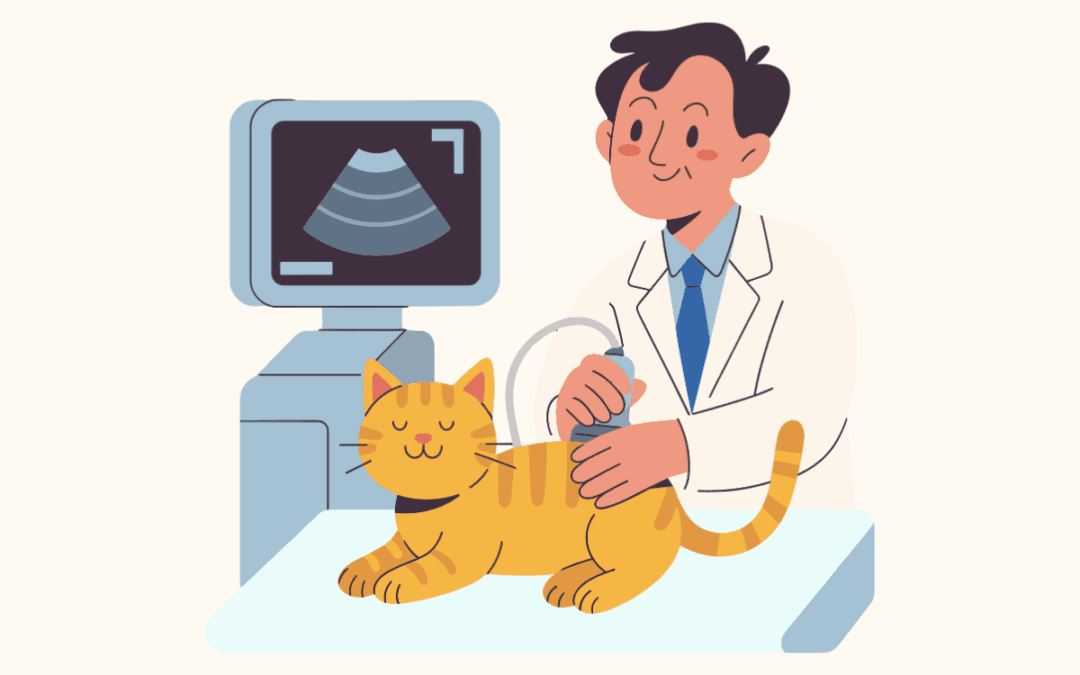
When your pet is unwell, getting to the root of the problem quickly and safely is everyone’s top priority. Sometimes, a physical exam and blood tests don’t tell the whole story. That’s where an ultrasound comes in. It’s a powerful diagnostic tool that gives us a real-time, inside look at what’s happening with your furry family member—all without any invasive procedures.
What Exactly Is an Ultrasound?
Think of it like the sonar a submarine uses, but for your pet’s body. An ultrasound machine uses a small, handheld probe called a transducer to send high-frequency sound waves into the body. These waves bounce off the organs and tissues, and a computer translates those returning echoes into a live video image.
Why Might My Pet Need an Ultrasound?
Your veterinarian may recommend an ultrasound for a variety of reasons. It’s an incredibly versatile tool that helps us investigate many common issues, including:
- Abnormal Bloodwork: When blood tests show changes in organ function (like the liver or kidneys), an ultrasound lets us see the structure of those organs for clues.
- Vomiting, Diarrhea, or Loss of Appetite: We can examine the stomach, intestines, and pancreas to look for inflammation, foreign objects, or other causes of gastrointestinal upset.
- Unexplained Weight Loss: An ultrasound allows a thorough check of all the abdominal organs to look for underlying diseases.
- Heart Murmurs or Breathing Problems: A specialized heart ultrasound, called an echocardiogram, allows us to watch the heart beat, measure its chambers, and see how well the valves are working.
- Changes in Urination: We can assess the bladder for stones, crystals, or tumors and examine the kidneys for disease.
- Fluid in the Abdomen or Chest: Ultrasound is excellent at detecting and evaluating fluid accumulation.
- Pregnancy: Just like in humans, we can use ultrasound to confirm pregnancy and check on the developing babies.
What Ultrasounds Can (and Can’t) Tell Us
Ultrasound is a fantastic tool, but like any technology, it has its strengths and limitations.
✅ Ultrasounds are GREAT for:
- Looking at Soft Tissues: It gives us a detailed view of the architecture and texture of organs like the liver, spleen, kidneys, and bladder.
- Finding Fluid: It’s the best tool for identifying abnormal fluid in the chest or abdomen.
- Assessing Blood Flow: Using a feature called Doppler, we can watch blood move through vessels and the heart.
- Guiding Needles: We can use the live image to safely guide a needle to collect fluid or tissue samples (a procedure called a fine-needle aspirate or biopsy).
- Detecting Tumors & Cysts: It helps us find abnormal masses within organs.
⚠️ Ultrasounds have a HARD TIME with:
- Gas: Sound waves can’t pass through gas, so it can be difficult to see inside gas-filled organs like the stomach or lungs.
- Bone: Bone blocks sound waves completely, so we can’t see what’s on the other side of it. X-rays are much better for evaluating bones.
- Function: While an ultrasound shows us what an organ looks like, it doesn’t always tell us how well it’s working. That’s why we often use it alongside other tests like bloodwork.
Advanced Imaging at ACES
At Animal Center for Emergency and Specialty (ACES), we are proud to offer comprehensive, state-of-the-art ultrasound services to help diagnose your pet. Our team is equipped to perform:
- Full Diagnostic Abdominal Ultrasounds
- Thoracic (Chest) Ultrasounds
- Cervical (Neck) Ultrasounds
- Echocardiograms (Heart Ultrasounds)
- Ultrasound-Guided Procedures, such as biopsies and fluid drainage.
Having this technology on-site allows us to get fast, accurate answers so we can create the best possible treatment plan for your pet.